
How to Measure Marketing Performance for Startups
Why Measuring Marketing Performance Matters
Startups rarely have unlimited budgets. Every pound spent on marketing needs to contribute towards building the business.
Effective measurement helps you answer questions such as:
Which channels are generating customers?
How much does it cost to acquire a customer?
Which campaigns are producing the best return?
Where are prospects dropping out of the funnel?
Which marketing activities are driving long-term value?
Should you increase, reduce or redistribute your marketing investment?
Without measurement, marketing can become a collection of disconnected activities rather than a growth engine.
The goal isn't to track everything. It's to identify the metrics that help you make better decisions.

The Most Important Startup Marketing Metrics
There are hundreds of marketing metrics you could track. Most startups don't need hundreds. A useful startup marketing dashboard should focus on a relatively small number of metrics covering reach, acquisition, conversion, cost and customer value.
1. Customer Acquisition Cost (CAC)
Customer Acquisition Cost measures how much you spend to acquire a new customer.
The basic calculation is:
CAC = Total Marketing & Sales Costs ÷ Number of New Customers
For example, if you spend £10,000 on marketing and acquire 200 customers:
£10,000 ÷ 200 = £50 CAC
CAC is one of the most useful metrics for understanding whether your growth model is sustainable. However, be careful about looking at CAC in isolation. A £50 customer acquisition cost could be excellent if customers generate £500 of lifetime value, but expensive if they only generate £60.
2. Customer Lifetime Value (LTV)
Customer Lifetime Value estimates how much revenue or profit a customer generates over the relationship with your business.
A simplified calculation is:
LTV = Average Customer Value × Average Customer Lifespan
Comparing LTV with CAC gives you a much better understanding of the economics of your marketing.
For example:
CAC = £50
LTV = £250
LTV:CAC = 5:1
This suggests a potentially attractive acquisition model. The exact ratio you should target will depend on your business model, margins, retention and growth strategy, but the principle is simple: the value created by acquiring a customer needs to justify the cost of acquiring them.
3. Conversion Rate
Conversion rate tells you what percentage of people take a desired action.
That action could be:
Making a purchase
Signing up
Booking a demo
Completing an application
Requesting a quote
Joining a mailing list
For example, if 5,000 people visit your website and 250 become leads:
250 ÷ 5,000 × 100 = 5% conversion rate
Conversion rate is particularly useful because it helps identify where improvements can be made without necessarily increasing your marketing budget. If you double your conversion rate, you can potentially double your customers without doubling your traffic.
4. Cost Per Lead (CPL)
For startups with a lead-generation model, Cost Per Lead can be an important acquisition metric.
CPL = Marketing Spend ÷ Number of Leads
However, don't assume that a cheaper lead is automatically better. A campaign generating leads at £10 each may look better than one generating leads at £25 each. But if the £10 leads rarely become customers while the £25 leads convert at a much higher rate, the more expensive campaign may actually be the better investment. Always connect lead generation metrics to downstream conversion and revenue.
5. Return on Ad Spend (ROAS)
ROAS measures the revenue generated for every pound spent on advertising.
ROAS = Revenue Attributed to Advertising ÷ Advertising Spend
If you spend £5,000 and generate £20,000 in attributed revenue:
ROAS = 4:1
ROAS can be useful for measuring paid advertising performance, particularly for ecommerce businesses. But it shouldn't automatically be treated as the ultimate marketing metric. Different channels can influence customers at different stages of the journey, and some businesses have repeat purchases or long sales cycles that make immediate revenue attribution less meaningful.
For startups, it's often better to look at ROAS alongside CAC, LTV, conversion rate and contribution margin. Industry and product type also make ROAS a metric that can be useful or not depending on how your product works.
6. Website Traffic
Website traffic is useful, but traffic alone isn't a measure of marketing success. A startup can increase traffic by 200% and still generate fewer customers.
Instead, look at:
Organic traffic
Paid traffic
Direct traffic
Referral traffic
Branded search
Non-branded search
Landing-page performance
Conversion rate by channel
The important question isn't simply: "How many people visited our website?" It's: "What did those visitors do?"
7. Engagement Metrics
Depending on your marketing strategy, engagement metrics can help explain what happens before conversion.
These might include:
Email open and click rates
Video engagement
Social engagement
Content downloads
Time on page
Returning visitors
Landing-page engagement
These are useful diagnostic metrics, but they shouldn't become vanity metrics. A post receiving 100,000 impressions is not necessarily more valuable than one receiving 10,000 impressions if the smaller audience generates substantially more customers.
One of the best ways for founders to understand marketing performance is to measure the entire customer journey rather than individual campaigns.
A simple funnel might look like:
Awareness → Website Visit → Lead → Qualified Lead → Customer → Repeat Customer
At each stage, measure the conversion rate and cost.
For example:
Measuring the Marketing Funnel
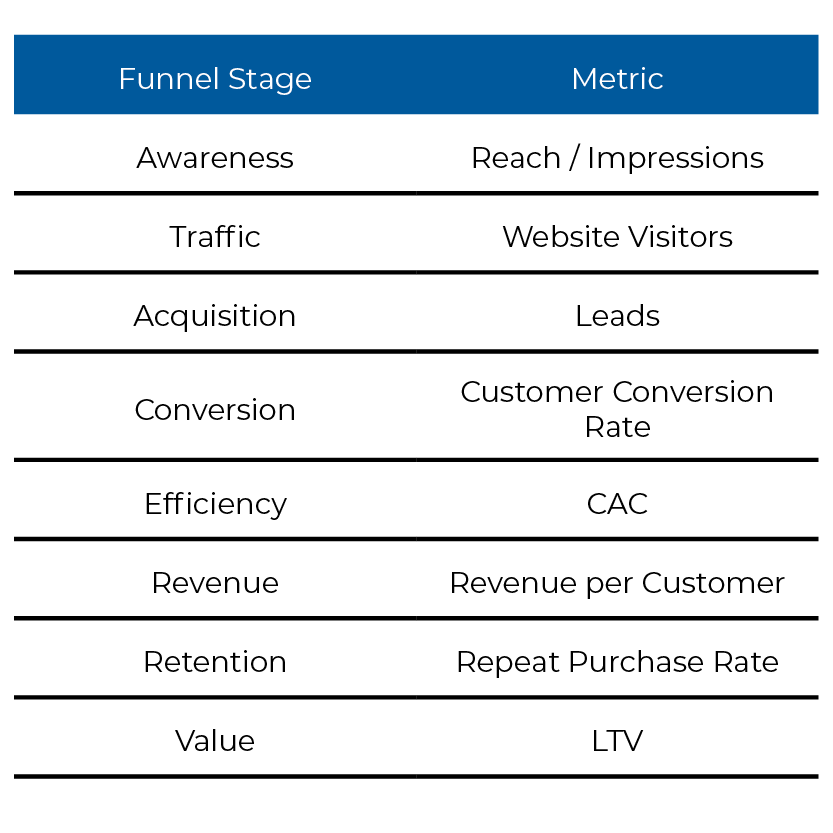
This gives you a much clearer picture of where growth is coming from and where your biggest opportunities sit.

Measure Marketing by Channel
Not every marketing channel should be judged in exactly the same way.
For example:
Paid search might be measured using CAC, conversion rate and revenue.
SEO might be measured using organic traffic, rankings, qualified traffic and conversions.
Content marketing might be measured using organic visibility, engagement, leads and assisted conversions.
Email marketing might be measured using engagement, conversion, revenue and retention.
Social media might initially focus on reach and engagement, but should increasingly be connected to website behaviour, leads and customers.
The mistake is applying one metric to every channel.
Instead, establish a consistent measurement framework while recognising the different roles each channel plays.

Don't Ignore Attribution
One of the biggest challenges in measuring marketing performance is attribution.
A customer might:
See your advert on social media
Search for your company on Google
Read an article
Visit your website again a week later
Sign up through an email
Become a customer
Which channel gets the credit?
Depending on your attribution model, the answer could be social, organic search, email, direct traffic or a combination.
This is why founders should be cautious about assuming that the last-click channel generated the entire customer.
As your business grows, consider moving from basic last-click attribution towards a more sophisticated approach using multi-touch attribution, incrementality testing or marketing mix modelling where appropriate.

What Should Founders Measure First?
If you're early-stage and don't have sophisticated analytics in place yet, start with five numbers:
1. Marketing spend
How much are you investing?
2. Leads or prospects
How much demand are you generating?
3. Customers
How many are actually converting?
4. CAC
How much does each customer cost?
5. Customer value
How much revenue or profit does each customer generate?
Once these are reliable, you can build more sophisticated measurement around them.

The Bottom Line
Measuring startup marketing performance isn't about creating a dashboard full of impressive-looking numbers.
It's about understanding which marketing activity creates business value.
The best founders don't simply ask:
"How many people saw our campaign?"
They ask:
"What did we spend, what did we generate, what did we learn, and what should we do next?"
Start with a small number of meaningful KPIs, connect marketing data to commercial outcomes and build your measurement sophistication as the business grows.
Good marketing measurement doesn't just report what happened. It helps you decide what happens next.
Need Help Measuring Your Startup Marketing?
At Startup Collective, we help founders turn marketing activity into a measurable growth engine, from strategy and acquisition through to SEO, paid media, analytics and attribution.
If you're spending money on marketing but aren't completely sure what's working, let's fix that.